
Sanctions in the Political Sphere and Their Effectiveness
Keywords:
political sanctions against Russia, EU sanctions architecture; political delegitimation, individual restrictive measures, targeted listings, visa and diplomatic restrictions, media and information influence restrictions, coalition signalling, institutional isolation, anti-circumvention policy, transit elites, para-state structuresAbstract
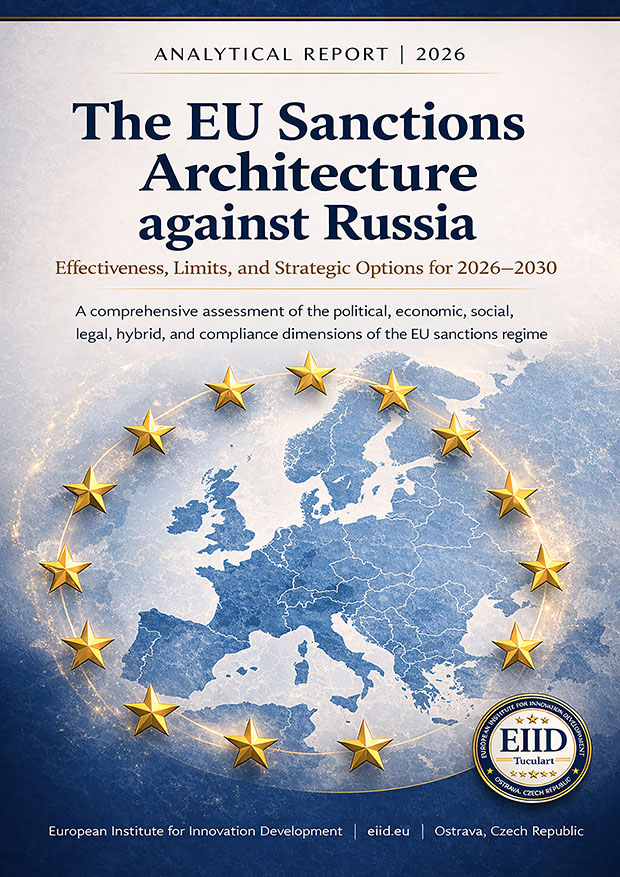
Part Two, Sanctions in the Political Sphere and Their Effectiveness, examines the political dimension of the EU sanctions regime against Russia as a distinct but interconnected layer of the wider sanctions architecture developed throughout the full edition. It argues that political sanctions should not be reduced to symbolic diplomacy, because they perform concrete functions of delegitimation, institutional isolation, coalition signalling, and restriction of Russia’s international room for manoeuvre. The section analyses the conceptual foundations of political sanctions, the reasons for their introduction against Russia, and the comparative relevance of historical analogues such as South Africa, Iran, Yugoslavia, and Belarus. A substantial part of the chapter is devoted to the practical review of three major political-sanctions tracks: individual restrictive measures, visa and diplomatic restrictions, and restrictions on information influence and media operations. The analysis shows that the effectiveness of these measures lies less in immediate coercion and more in their cumulative ability to personalise responsibility, constrain enabling networks, reduce normalisation, and reinforce the broader sanctions regime across other domains. At the same time, the chapter carefully identifies the structural limits of political sanctions, including adaptation, circumvention, legal constraints, implementation gaps, and uneven international synchronisation. A major contribution of this part is its forward-looking 2026–2030 assessment, which evaluates the long-term durability of political sanctions under different strategic conditions and policy scenarios. The section concludes by proposing ways to increase pressure through deeper personalisation of sanctions and broader targeting of transit elites and para-state structures that help sustain Russian state power and external influence. Within the logic of the whole publication, Part Two provides the essential political framework for understanding how sanctions shape not only behaviour, but also legitimacy, access, status, and the international operating environment of the Russian Federation.
Downloads
Downloads
Published
Issue
Section
License
Copyright (c) 2026 Tuculart Edition

This work is licensed under a Creative Commons Attribution-NonCommercial-NoDerivatives 4.0 International License.
The Tuculart Edition (ESEJ) is an open access journal. Articles are available free of charge as PDF files on the website of the European Institute for Innovation Development. PDF files can be previewed with Acrobat Reader from www.adobe.com.
All the books of the edition are published under a Creative Commons Attribution 4.0 Generic (CC BY 4.0) International license.
According to the Creative Commons Attribution 4.0 Generic (CC BY 4.0) International license, the users are free to Share — copy and redistribute the material in any medium or format for any purpose, even commercially (the licensor cannot revoke these freedoms as long as you follow the license terms).


