
Sanctions in the Economic Sphere and Their Effectiveness
Keywords:
economic sanctions against Russia, structural economic pressure, financial sanctions and banking restrictions, energy sanctions, oil price cap, trade and industrial restrictions, technology denial, export controls, transport and logistics restrictions, anti-circumvention governance, sanctions effectiveness, economic outlook 2026–2030Abstract
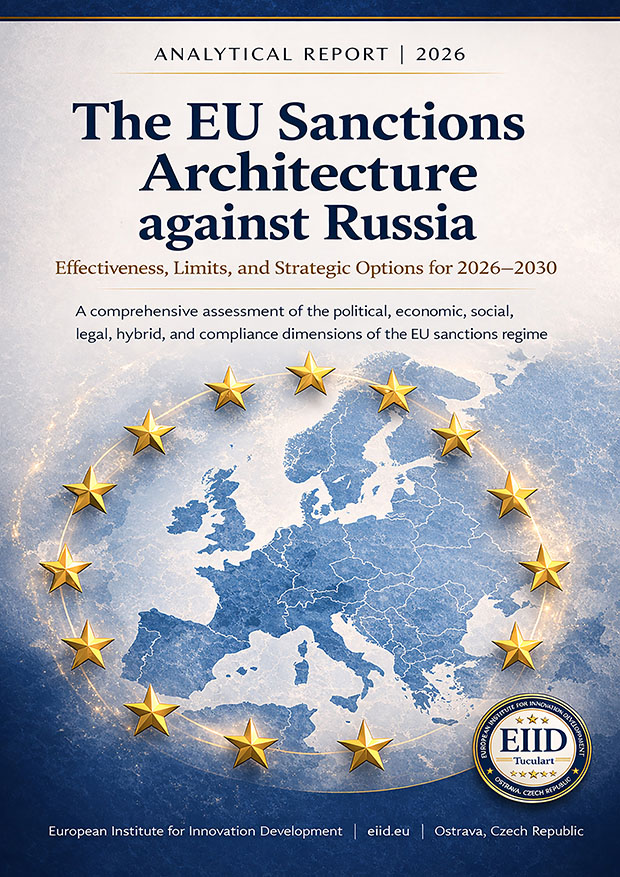
Part Three, Sanctions in the Economic Sphere and Their Effectiveness, examines the economic dimension of the EU sanctions regime against Russia as a system of structural pressure designed to constrain financial capacity, technological access, trade efficiency, energy revenues, and logistical reach rather than to produce a single immediate shock. It shows that economic sanctions operate cumulatively through persistent friction across banking, capital markets, industrial supply chains, energy export channels, transport corridors, and compliance-sensitive commercial services. A central contribution of this part is its distinction between contemporary economic sanctions and classical embargoes, arguing that the current regime works through modular restrictions, financial choke points, technology denial, and anti-circumvention governance. The section gives detailed attention to four major economic tracks: financial sanctions and the banking sector, energy sanctions, trade-industrial and technological restrictions, and transport and logistics constraints. It demonstrates that the effectiveness of these measures lies not only in reducing current revenues or trade volumes, but also in increasing substitution costs, degrading long-term productive capacity, and narrowing Russia’s strategic room for economic adaptation. At the same time, the chapter carefully analyses the limits of economic coercion, especially rerouting through third countries, shadow-fleet operations, currency substitution, market opacity, and the continuing role of global commodity demand. A major strength of this part is its forward-looking perspective, which assesses the prospectiveness of economic sanctions for 2026–2030 and identifies the conditions under which their effectiveness can be preserved or strengthened. It also develops proposals for intensifying pressure through secondary sanctions, extraterritorial measures, and closer linkage between sanctions policy and Europe’s energy decarbonisation strategy. Within the logic of the whole edition, Part Three provides the core analysis of how sanctions affect Russia’s material capabilities, fiscal resilience, industrial reproduction, and access to the infrastructures of external economic power.
Downloads
Downloads
Published
Issue
Section
License
Copyright (c) 2026 Tuculart Edition

This work is licensed under a Creative Commons Attribution-NonCommercial-NoDerivatives 4.0 International License.
The Tuculart Edition (ESEJ) is an open access journal. Articles are available free of charge as PDF files on the website of the European Institute for Innovation Development. PDF files can be previewed with Acrobat Reader from www.adobe.com.
All the books of the edition are published under a Creative Commons Attribution 4.0 Generic (CC BY 4.0) International license.
According to the Creative Commons Attribution 4.0 Generic (CC BY 4.0) International license, the users are free to Share — copy and redistribute the material in any medium or format for any purpose, even commercially (the licensor cannot revoke these freedoms as long as you follow the license terms).


