
Analytical Conclusions
Keywords:
multidimensional sanctions effectiveness, cumulative pressure architecture, strategic value of EU sanctions, comparative sanctions assessment, limits of sanctions-based coercion, authoritarian adaptation under sanctions, anti-circumvention and compliance governance, political transformation under sanctions, coalition durability and legal resilience, sanctions fatigue and diminishing returnsAbstract
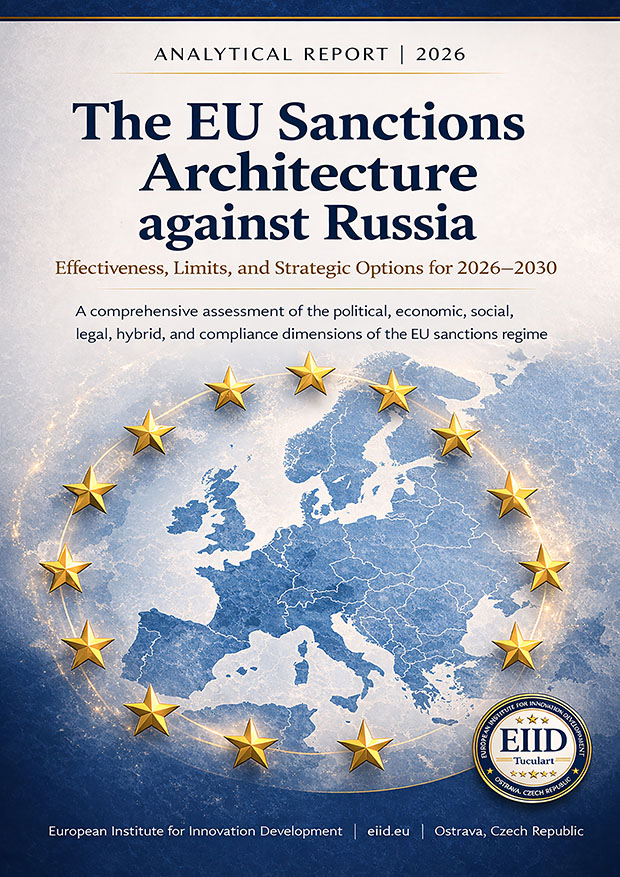
Part Eight, Analytical Conclusions, brings together the findings of the entire publication and offers an integrated judgement on the EU sanctions regime against Russia as a multidimensional system rather than a collection of isolated measures. It argues that the key methodological mistake in public debate is to ask whether sanctions have simply “worked” or “failed”, because their real effects differ across political, economic, social, legal, hybrid, and compliance dimensions. The chapter shows that the regime has been strongest where it degrades capabilities, hardens compliance, narrows external options, and reinforces coalition coordination, while its weakest point remains the limited capacity of sanctions alone to compel rapid political reversal in Moscow. A major contribution of this part is its concept of cumulative pressure architecture, according to which sanctions gain strategic force through interaction over short-, medium-, and long-term horizons rather than through any single package taken in isolation. The section also provides a sober assessment of the structural limits of sanctions-based coercion, especially in relation to a large adaptive authoritarian state capable of redistribution, repression, rerouting, and narrative mobilisation. It further analyses the internal constraints of the EU and its partners, including legal proportionality, unanimity, implementation asymmetries, compliance burdens, coalition maintenance, and the risk of diminishing returns or sanctions fatigue. At the same time, the chapter rejects dismissive conclusions, arguing that the current regime has already acquired substantial strategic value as a durable instrument of European governance, non-normalisation, and long-term attritional constraint. An especially important analytical move in this part is the discussion of how sanctions may contribute to political transformation in Russia only indirectly, through fiscal strain, technological degradation, institutional mutation, and elite-level recalculation. Overall, Part Eight serves as the intellectual synthesis of the whole edition, defining both the real achievements and the real limits of the EU sanctions architecture in 2022–2025 and clarifying the conditions under which it may remain consequential in the years ahead.
Downloads
Downloads
Published
Issue
Section
License
Copyright (c) 2026 Tuculart Edition

This work is licensed under a Creative Commons Attribution-NonCommercial-NoDerivatives 4.0 International License.
The Tuculart Edition (ESEJ) is an open access journal. Articles are available free of charge as PDF files on the website of the European Institute for Innovation Development. PDF files can be previewed with Acrobat Reader from www.adobe.com.
All the books of the edition are published under a Creative Commons Attribution 4.0 Generic (CC BY 4.0) International license.
According to the Creative Commons Attribution 4.0 Generic (CC BY 4.0) International license, the users are free to Share — copy and redistribute the material in any medium or format for any purpose, even commercially (the licensor cannot revoke these freedoms as long as you follow the license terms).


